




The long waited Henry Tax Review was provided to the Government in December 2009 but was kept out of the public arena until the Government released the report on 30 April 2010.
The overall objective of the Henry Report is to strengthen growth to maximise Australia's wealth creation potential. The review was charged with completing a 'root and branch' approach whilst providing a 'blue print' for the Australian tax system to:
Even though Australia survived the Global Financial Crisis without descending into a recession, we are faced with the challenges of:
Consequently, the Henry Tax Review contained 138 comprehensive recommendations covering personal income tax, superannuation, family assistance payments, small business and retirement incomes. For a copy of the full report please click here.
Even though the report contained a large number of recommendations, the Government has initially responded with some taxation recommendations as outlined below:
One of the more interesting recommendations from Henry has been the recommendation of changes to the individual marginal tax rates (MTR) and the abolishment of all tax offsets which has had minimal media coverage.
The Henry report has recommended the following changes to individual MTR as shown in table 1:
Income range ($) |
Tax rate% |
Tax payable |
|---|---|---|
0 – 25,000 |
0 |
Nil |
25,001 – 180,000 |
35 |
Nil + 35% of excess over $25,000 |
180,001 + |
45 |
$54,250 + 45% of excess over $180,000 |
The chart below from the Henry Tax Report outlines the recommended changes and the potential effect for income tax paying Australians against current average tax rates
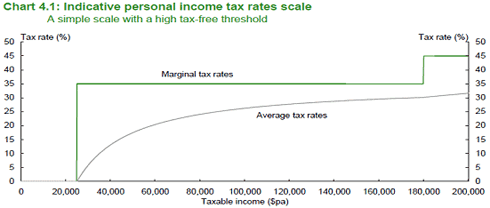
Source: Treasury estimates.
We have compared the recommendation to the current marginal tax rates within table 2, where you will see that an average Australian income earner on $58,000 pa would be paying more in income tax.
Taxable income |
Henry Tax Review |
Tax withheld (2010-11) |
Difference |
|---|---|---|---|
$25,000 |
$0 |
$1,350 |
$1,350 |
$50,000 |
$8,750 |
$8,550 |
-$200 |
$58,000 |
$11,550 |
$10,950 |
-$600 |
$80,000 |
$19,250 |
$17,550 |
-$1,700 |
$125,000 |
$35,000 |
$34,200 |
-$800 |
$150,000 |
$43,750 |
$43,450 |
-$300 |
$180,000 |
$54,250 |
$54,550 |
$300 |
$200,000 |
$61,250 |
$63,550 |
$2,300 |
There are a number of tax minimisation strategies that will impact these recommendations. We have outlined a few strategies below:
John and Mary are aged 52 and 50 respectively. They would both like to retire in eight years and require sufficient accumulated wealth to meet their goal. They have two children aged 18 and 16 and both plan to complete university education. John and Mary both work and earn annual salaries of $120,000 and $55,000 respectively. John's superannuation balance is $350,000 and Mary's is $75,000. John's mother has recently passed away and has left him $300,000. They have no debts.
What financial planning strategies would you recommend John and Mary under the current taxation law and if the Government implemented Henry's taxation plan?
Financial planning strategy |
Current tax law |
Henry Tax Proposal |
|---|---|---|
Salary sacrifice to super |
Depending on cash flow requirement, you could utilise the full concessional cap for John and reduce Mary’s salary to $30,000. |
Utilise John’s $50,000 concessional cap but salary sacrifice Mary’s to $25,000. |
Contribute $300,000 surplus to super |
Utilise the $300,000 and contribute to Mary’s super to provide balance of super. |
|
Invest $300,000 via a family trust |
Could contribute to each child up to their tax-free threshold. Adult child will be entitled to $16,000 (for 2010/11 year including low income tax offset of $1,500) whereas the minor will be subject to $3,335. |
Tax-free income threshold for adult child will be $9,000 more each year (ie $25,000 - $16,000). |
Invest surplus funds via private company or insurance bond – IOOF WealthBuilder |
Announced reduction in company and bond rates to 29% will make it more attractive as an investment vehicle for individuals like Mary that are in the 30% tax bracket. Assume the kids will be working, a saving of 1% tax (ie 30% less 29%) will be realised. |
Assume kids will be working, a tax saving under this investment will be 6% pa (ie 35% flat tax rate - 29% less bond tax rate). |
As the average Australian would be worse off under these proposed changes to the MTR, it will be interesting to see if this would ever become law. Having said that, if it does get implemented, we should see the real value of full ongoing financial planning advice.
 Viewpoint
Contents
Newsflash: Drawdown relief for account-based pensions extended into 2010/2011 financial year
Newsflash: The Super System Review Final Report – Cooper Review
Technical Strategy: Limited recourse borrowing arrangements
Technical Strategy: Henry Tax recommendation to marginal tax rates – what could it mean?
Technical Strategy: IOOF Pursuit provides added strategy benefits
Technical Strategy: Small APRA Funds
Product Spotlight: Creating wealth tax effectively via WealthBuilder
Our People
Performance Data
Viewpoint
Contents
Newsflash: Drawdown relief for account-based pensions extended into 2010/2011 financial year
Newsflash: The Super System Review Final Report – Cooper Review
Technical Strategy: Limited recourse borrowing arrangements
Technical Strategy: Henry Tax recommendation to marginal tax rates – what could it mean?
Technical Strategy: IOOF Pursuit provides added strategy benefits
Technical Strategy: Small APRA Funds
Product Spotlight: Creating wealth tax effectively via WealthBuilder
Our People
Performance Data
 RSS feed