




The start of the new financial year marks the reduction in the concessional contribution caps due to the changes announced within the 2009 Federal Budget. This reduction will spark a rethink in taxation and retirement planning strategies post 1 July 2009.
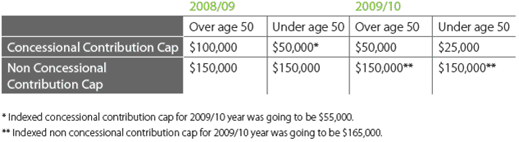
As you will know, from 1 July 2009 the concessional contributions cap has been halved to $25,000 p.a. from its current limit of $50,000 (as outlined in Table 1). A reduction will also apply to the transitional cap for concessional contributions. The transitional concessional cap will be reduced from its current annual level of $100,000 p.a. to $50,000. The transitional concessional cap of $50,000 will apply for the 2009/10, 2010/11 and 2011/12 years of income.
The Government has ruled out any changes to the non-concessional cap and the three year averaging rule. However, what has been affected is the benefit of indexation for the 2009/10 year which was meant to move up to $165,000 (as shown in table 1). This means the non-concessional cap will remain at $150,000 along with the three year rolling cap of $450,000 available to clients under age 65 from 1 July 2009.
Table 1 – Changes to the contributions caps
The reduction in the contribution caps will have an adverse impact on many of your clients’ retirement plans. To combat these changes, a client will need to contribute smaller amounts into superannuation from an earlier age, whilst accumulating wealth outside of super in a tax effective manner. Some of the possible alternatives include commencing a gearing strategy or investing via an investment bond.
For imminent retirees over age 50, the reduction in the transitional contribution cap to $50,000 could have a significant impact on their contribution planning strategy. As an alternative, imminent retirees can seek to make non-concessional contributions or commence a gearing strategy to overcome a shortfall in their retirement savings.
Take the case of Robert who is age 50. He was planning to make concessional contributions of $100,000 p.a. up until 30 June 2012 (when the cap would revert back to the standard concessional contribution cap). Due to the changes announced in the budget, the maximum concessional contribution has been reduced to $50,000 p.a.
For Robert the reduction in the concessional contribution cap for over 50’s by $50,000 p.a. (or $42,500 net of contributions tax) for the next three years, will result in his super balance reducing by approximately $300,000 1 in 10 years time.
Like Robert, this can have a serious impact on many of your client’s retirement plans and leave them with a retirement savings shortfall. To address this gap, Robert could consider a combination of strategy options over the next three years including additional non-concessional contributions into superannuation and gearing.
Strategy Option 1 – Non-Concessional Contributions
To bridge this shortfall in his superannuation balance in 10 years time (i.e. $300,000) Robert could make additional non-concessional super contributions. However, because non-concessional contributions are made from post-tax dollars Robert (who is on the top marginal tax rate, 45% plus Medicare levy) would now need to earn approximately $80,000 p.a. in order to be able to make non-concessional contributions of $42,500 p.a. over the next 3 years. This would effectively give the client the same estimated super balance in 10 years time but Robert will pay an additional $37,200 p.a. (approximately) in personal income tax from 1 July 2009 as a result of the change.
Strategy Option 2 – Non-concessional Contributions and Gearing
With the change to the concessional contribution cap, Robert may not have the ability to take $80,000 in income (i.e. an additional $30,000) in order to make a $42,500 non-concessional contribution. It may be more likely that they take $50,000 as regular income, paying tax at marginal tax rates and making a non-concessional contribution.
Making non-concessional contributions of $26,750 p.a. over the next 3 years (i.e. $50,000 less personal income tax of $23,250) will only generate an estimated super balance of approximately $185,000 (assuming returns used and outlined above) in 10 years time leaving Robert with a retirement savings shortfall of approximately $115,000. As well as having this shortfall, Robert will also pay an additional $23,250 p.a. in personal income tax from 1 July 2009 as a result of the change.
Robert could commence a gearing strategy (incorporating a risk assessment) outside of superannuation to reduce this savings shortfall. Assuming Robert implements a $225,000 gearing strategy in year 1 using a home or investment equity loan in conjunction with the non-concessional contributions of $26,750 p.a., Robert should be able to accumulate the same savings balance of $300,000 in 10 years time.
Clients who are under 75 years of age, and are not considered ‘employees’ for superannuation guarantee purposes during an income year, are eligible to claim a tax deduction for personal superannuation contributions (i.e. concessional contribution) they make in that year.
If a client is engaged in employment activities (e.g. holding an office or appointment, or engaging in work) that results in them being treated as an employee for superannuation guarantee purposes during the income year, they must pass the ‘10% test’ to be eligible to claim a deduction for their own super contributions. That is, less than 10% of total assessable income and reportable fringe benefits must be ‘attributable to’ those employment activities.
Generally, claiming a tax deduction for personal superannuation contributions has been associated only with self-employed people. However, they can be made by retirees and unemployed individual’s under age 65.
For many clients, restructuring their assets by selling investments at retirement and contributing the proceeds into superannuation is a common occurrence. A retiree like Joan (below) who is eligible to make concessional contributions can manage her capital gains tax liability upon disposal of her investment property. In her case the reduction of the concessional contributions cap from 1 July 2009 will increase her personal income tax payable.
Joan (age 56) recently sold an investment property which generated a gross capital gain of $280,000 in order to boost her superannuation savings. Joan is eligible to make a concessional contribution into superannuation to reduce the capital gains tax payable on the sale of her investment property.
Joan will pay an additional $19,750 (i.e. $41,386 - $21,618) in personal income tax from 1 July 2009 due to the reduction in the concessional cap from $100,000 to $50,000 (as shown in table 2). If Joan delayed the sale until after 1 July 2012 her personal income tax liability would increase by $29,625 (i.e. $51,243 - $21,618).
Table 2 – Increased personal income tax on sale of investment property
| No concessional contribution | Concessional contribution $100,000 < 1 July 2009 |
Concessional contribution $50,000 > 1 July 2009 |
Concessional contribution $25,000 > 1 July 2012 |
|
|---|---|---|---|---|
| Investment Income | $46,500 |
$46,500 |
$46,500 |
$46,500 |
| Discounted Capital Gain | $140,000 |
$140,000 |
$140,000 |
$140,000 |
| GROSS INCOME | $186,500 |
$186,500 |
$186,500 |
$186,500 |
| Less: concessional contribution | $0 |
$100,000 |
$50,000 |
$25,000 |
| TAXABLE INCOME | $186,500 |
$86,500 |
$136,500 |
$161,500 |
| Tax Payable * | $61,573 |
$21,618** |
$41,368 |
$51,243 |
| INCOME AFTER TAX | $124,928 |
$164,883 |
$145,133 |
$135,258 |
* 2009/2010 taxation scales and includes Medicare Levy.
** Based on 2009/2010 taxation scales for consistency purposes.
The reduced concessional contribution cap may prolong the time taken to complete this restructuring otherwise clients will incur higher capital gains tax than expected upon the sale of their investments. As a rule of thumb, the $50,000 concessional contribution cap will allow a limit on the gross capital gain of $100,000. This equally applies to the $25,000 concessional contribution cap with a limit of $50,000.
Joan is certainly disadvantaged by selling a non-divisible asset such as property. In contrast, if Joan had an investment portfolio, she could take longer to transition funds into superannuation over succussive financial years whilst generating gross capital gains within the above rules of thumb.
The 2009 Federal Budget will have an impact on your client’s retirement plans and strategies employed after 1 July 2009. Even though your client’s concessional contributions may need to be revised downwards to avoid exceeding the caps, the opportunity still exists prior to 30 June 2009 to maximise the current concessional contributions caps.
In the coming editions of @dviser Magazine we will revisit how the reduced concessional contribution caps will affect strategies post 1 July 2009. In particular, traditional products like investment bonds (for example, IOOF WealthBuilder) could be used to compliment existing strategies for high income earners. For more information about WealthBuilder, please click here or refer to the article on Investment Bonds in this issue.
1Based on nine per cent p.a. including growth and income
 Viewpoint
Contents
Newsflash: Time is running out – get all concessional contributions in before 30 June
Newsflash: Work smart with online forms
Newsflash: Adviser Update: Temporary Resident Superannuation
Technical Strategy: Post Budget 2009 – Strategy tips to use before 30 June 2009
Technical Strategy: New contribution caps warrant a rethink of retirement savings strategy
Technical Strategy: ATO Back Flips on Ordinary Time Earnings for Super Guarantee
Technical Strategy: Adviser Alert - Excess Contributions Tax
Product Spotlight: Budget 2009: Investment bonds - a reliable alternative in an uncertain landscape
Product Spotlight: Online Insurance proves popular
Our People
Performance Data
Viewpoint
Contents
Newsflash: Time is running out – get all concessional contributions in before 30 June
Newsflash: Work smart with online forms
Newsflash: Adviser Update: Temporary Resident Superannuation
Technical Strategy: Post Budget 2009 – Strategy tips to use before 30 June 2009
Technical Strategy: New contribution caps warrant a rethink of retirement savings strategy
Technical Strategy: ATO Back Flips on Ordinary Time Earnings for Super Guarantee
Technical Strategy: Adviser Alert - Excess Contributions Tax
Product Spotlight: Budget 2009: Investment bonds - a reliable alternative in an uncertain landscape
Product Spotlight: Online Insurance proves popular
Our People
Performance Data
 RSS feed